
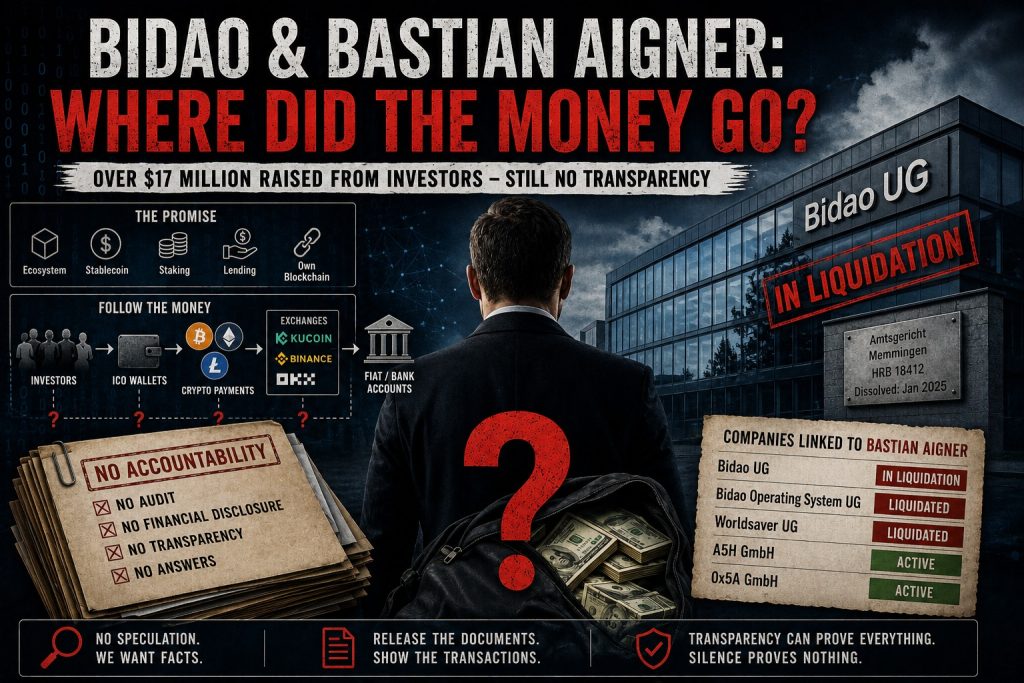
A call for transparency and accountability
Bidao was launched around 2019/2020 as an ambitious blockchain and DeFi project. Investors were presented with plans for an ecosystem that would include a stablecoin, staking, lending and ultimately its own blockchain infrastructure.
A substantial amount of money was raised through the project’s token sale.
Yet years later, one of the most basic questions remains unanswered in a way that can be independently verified:
How much money was actually raised, where did it go, and what was ultimately built with it?
The original token sale offered up to 1.95 billion BID tokens at a price of $0.01 per token. This represented a theoretical maximum sale value of approximately $19.5 million.
That does not mean $19.5 million was actually received.
Establishing the real amount would require access to the relevant cryptocurrency wallets, banking records, token-sale records and financial accounts.
One of the central people behind the project was Bastian Aigner. German corporate registry information shows that Aigner served as managing director (Geschäftsführer) of Bidao UG. The company has since entered liquidation, with Aigner registered as its liquidator.
Years after the token sale, investors are therefore still asking fundamental questions:
How much money was actually raised? What happened to it? What was actually built? And why has a complete and independently verifiable financial account never been provided to investors?
From ambitious promises to years of delays
Bidao initially presented itself as a serious DeFi project with major technical ambitions.Plans included stablecoin functionality, staking, lending and an extensive blockchain ecosystem.
Over the following years, new roadmaps, announcements and development plans appeared. At the same time, important milestones were repeatedly delayed. The direction of the project also changed, with attention eventually shifting toward the Bidao Smart Chain and other technical developments. Delays alone do not prove wrongdoing.
Blockchain development is difficult. Business models can fail. Technical strategies can change. Startups can run out of money or ultimately be closed.
The real issue is different: Investors have never received sufficient independently verifiable information showing what happened to the capital originally raised for the project.
How much money was actually raised?
According to publicly available information, the original token sale offered up to 1.95 billion BID tokens at $0.01 each. That created a theoretical maximum sale value of approximately $19.5 million. But a theoretical maximum is not the same as the amount actually received.
Determining the real figure would require, among other things:
- the original cryptocurrency receiving addresses;
- bank statements belonging to the relevant entities;
- records from exchanges and payment providers;
- records showing how many tokens were actually sold;
- and the financial accounts of the relevant Bidao entities.
As far as publicly known, no complete independent reconstruction of these records has ever been made available to token holders. That leaves one of the most fundamental questions surrounding Bidao unresolved: How much capital did the project actually receive?
The published balance sheet of Bidao UG
Some financial information concerning Bidao UG is publicly available. Data derived from published German financial statements indicates that Bidao UG reported approximately:
| Year | Reported balance sheet total |
|---|---|
| 2020 | approximately €2.30 million |
| 2021 | approximately €1.46 million |
These figures must be interpreted carefully. A balance sheet total is not the same as the total amount received during a token sale.
Money may have been spent during the year. Crypto assets may have been sold or transferred. Liabilities may have arisen, and digital assets may have been treated differently for accounting purposes. These figures therefore do not prove that money disappeared.
But they raise an important question:How do the proceeds from the Bidao token sale reconcile with the official financial accounts of Bidao UG?
With access to the complete accounting records, that should be possible to reconstruct.
Bidao UG started with €1 in share capital
The German corporate history contains another notable detail. The company that later became Bidao UG (haftungsbeschränkt) was originally registered in May 2019 under the name Middle Earth Dain Verwaltung Unternehmergesellschaft (haftungsbeschränkt).
Its registered share capital was just €1.
In August 2019, the company was renamed Bidao UG and Bastian Aigner became its managing director. Its registered corporate purpose included the development of blockchain technology. A German UG can legally be established with extremely low share capital. The €1 figure is therefore not evidence of anything improper. It does, however, make clear that any substantial capital later controlled by the company did not originate from its initial share capital.
The subsequent financial flows are therefore essential to understanding the financial history of Bidao.
The companies around Bastian Aigner
Research into German corporate records shows that Bastian Aigner was not only involved with Bidao UG. Public corporate information shows connections with several entities, including:
| Company | Connection to Bastian Aigner | Status |
| Bidao UG | Managing director, later liquidator | In liquidation |
| Bidao Operating System UG | Management/liquidation role | Liquidation completed/company terminated |
| Worldsaver UG | Management/liquidation role | Liquidation completed/company terminated |
| A5H GmbH | Managing director | Active |
| 0x5A GmbH | Managing director | Active |
The existence of these companies does not prove that money raised for Bidao was transferred to them. However, they are relevant to any serious financial reconstruction. An independent investigation should establish whether transactions, asset transfers, services or transfers of intellectual property took place between Bidao and any of these entities.
Bidao UG — in liquidation since 2025
Bidao UG is registered under HRB 18412 at the Amtsgericht Memmingen. In January 2025, the company was registered as dissolved and Bastian Aigner was registered as liquidator. Liquidation does not in itself indicate fraud or financial misconduct. Companies can be liquidated for many legitimate reasons. However, when a company connected to a project that raised substantial investor capital enters liquidation, obvious questions arise.
What assets remained when liquidation began?
What cryptocurrency holdings remained?
What money remained in bank accounts?
What liabilities and receivables existed?
Who owned the project’s software and intellectual property?
And what will happen to any remaining assets?
Token holders have not been provided with a complete public liquidation account capable of answering all of these questions.
Bidao Operating System UG — another Bidao company that no longer exists
In addition to Bidao UG, another company existed under the name:
Bidao Operating System UG (haftungsbeschränkt).
This entity was also connected to Bastian Aigner. The company was eventually dissolved and liquidated. By the end of 2023, its liquidation had been completed and the company had ceased to exist. That creates another important question:
What role did Bidao Operating System UG play within the Bidao project?
Was it a development company?
Were developers paid through it?
Did it own software, source code or intellectual property?
Did it receive funds from Bidao UG or directly from activities connected with the project?
What assets remained when the company was liquidated?
And where did any remaining assets go?
The liquidation of a company does not prove misuse of funds.
But when a legal entity carrying the name of the blockchain project itself is terminated, investors have legitimate reasons to ask what that company did and how its assets were ultimately handled.
Worldsaver UG — also liquidated
Bastian Aigner was also connected to Worldsaver UG (haftungsbeschränkt). This company was likewise liquidated and ultimately removed from the commercial register. Again, the existence or closure of Worldsaver UG does not demonstrate that Bidao funds were transferred to the company. But an independent audit should be capable of determining whether transactions took place between the entities.
If no such transactions occurred, the records can establish that. If transactions did occur, investors should be able to see the amounts, dates, services provided and commercial basis for those transactions.
A5H GmbH — established in 2020
Another relevant company is A5H GmbH. According to German corporate records, the company was established in 2020 with registered share capital of €25,000.
Bastian Aigner became its managing director.
Its corporate purpose includes acquiring, holding and managing interests in other companies, as well as consulting and IT-related activities. The timing is relevant because A5H was established during a period in which Bidao was highly active and the original token sale was still ongoing or approaching its planned completion. This does not establish that A5H was funded with money from Bidao. It does, however, create a specific and answerable question:
Was any money, service, asset or other economic value originating from Bidao directly or indirectly used to establish, finance or operate A5H GmbH?
If not, the accounting records should be capable of demonstrating that. If transactions did take place, their amount, timing, purpose and legal basis should be identifiable.
0x5A GmbH — several names, one company
Another relevant entity is 0x5A GmbH. This company has operated under several names:
Interlink Technologies GmbH → xProductivity GmbH → Interlink Labs GmbH → 0x5A GmbH.
The company was established in 2021. This is important because some public accusations have suggested that this specific company was already being used during the original Bidao token sale.Based solely on the corporate registration history, that claim cannot be established without additional evidence. What can be examined is the later ownership structure.
Public corporate information indicates that A5H GmbH owns 100% of 0x5A GmbH, while Bastian Aigner is connected to both companies as managing director. The structure can therefore be represented as:
Bastian Aigner → A5H GmbH → 0x5A GmbH
Again, this corporate structure does not establish a financial connection with Bidao. The relevant question is:
Did any Bidao entity conduct financial transactions with A5H, 0x5A or the predecessors of 0x5A, and if so, what were those transactions for?
What the corporate records show
Based on publicly available corporate information, several facts can be established:
- Bastian Aigner served as managing director of Bidao UG;
- Bidao UG is now in liquidation;
- a separate company called Bidao Operating System UG existed;
- that company was subsequently liquidated and terminated;
- Worldsaver UG was also liquidated and terminated;
- A5H GmbH was established in 2020 and remains active;
- 0x5A GmbH was established in 2021 and remains active;
- and public corporate information indicates that A5H owns 0x5A.
These are corporate facts that can be investigated and verified.
What these records do not prove
It is equally important to state what these corporate records do not establish. The available corporate information does not prove that Bastian Aigner:
- misappropriated funds from the Bidao token sale;
- transferred Bidao funds to A5H;
- transferred Bidao funds to 0x5A or its predecessors;
- personally received large amounts of money from the token sale;
- or deliberately concealed project assets from investors.
Claims of that nature require financial and blockchain-forensic evidence. That is precisely why an independent audit matters.
Where did the money go?
When substantial amounts of capital are received through a token sale, those funds should leave a financial trail. Cryptocurrency provides an additional advantage for investigators: many transactions remain permanently visible on public blockchains. A financial reconstruction should therefore begin with the original token-sale receiving addresses. Where possible, each flow should then be followed:
Investor → ICO wallet → intermediary wallet → exchange or other wallet → bank account or final destination
Traditional financial records must then complete the picture. For example, if cryptocurrency was transferred to an exchange, sold and withdrawn as euros or dollars, the publicly visible blockchain trail may end at the exchange. From that point onward, exchange records, bank statements and company accounting records become necessary. Blockchain analysis alone can therefore never reconstruct the entire financial history of Bidao.
Public allegations are not proof
Serious allegations concerning the destination of money raised by Bidao have circulated online. Some investors have alleged that funds may have been transferred to other companies or individuals. Such claims should not be presented as established facts without independent evidence.
A social-media post, investor statement, criminal complaint or petition is not a judicial finding. A complaint is not a conviction. An allegation is not a proven fact.
That is precisely why an independent reconstruction is necessary. Without financial transparency, competing narratives remain. The answer is not more speculation.
The answer is evidence.
The role of Bastian Aigner
Bastian Aigner occupied a central management position during an important part of Bidao’s history. Public corporate records connect him with Bidao UG, Bidao Operating System UG, Worldsaver UG, A5H GmbH and 0x5A GmbH. That makes Aigner an important person in understanding how the legal and financial structure surrounding Bidao was organised. It does not mean that he is personally responsible for every activity conducted by those companies. It does mean that investors have legitimate reasons to request clarification regarding the financial relationships between these companies and the Bidao project.
What an independent audit should investigate
An independent financial and blockchain-forensic investigation should at minimum answer the following questions:
- How many BID tokens were actually sold during the token sale?
- How much cryptocurrency and fiat currency was received?
- Which wallets were used?
- Which bank accounts were used?
- Which exchanges were used?
- Which crypto assets were sold or converted into fiat?
- How much was spent on software development?
- Which developers and companies were paid?
- How much was spent on management, staff, marketing and advisers?
- What payments were made to related persons or companies?
- Were transactions conducted with Bidao Operating System UG?
- Were transactions conducted with Worldsaver UG?
- Were transactions conducted with A5H GmbH?
- Were transactions conducted with 0x5A GmbH or its predecessors?
- What intellectual property was developed and who owns it today?
- What assets existed when Bidao UG entered liquidation?
- What liabilities existed?
- What assets remain in the liquidation?
- What will happen to any remaining assets?
This is about more than the price of BID
For many investors, this issue is no longer simply about whether BID will ever increase in value. It is about trust and accountability. A blockchain project does not have to succeed to have acted honestly.
A startup can fail. Technology can fail. A roadmap can change. A company can eventually be liquidated.
But when investors provide substantial capital for the development of a project, it is reasonable to expect that it should eventually be possible to establish:
how much money was received and what happened to it.
What we are asking for
BidaoGate is therefore calling for transparency and independent accountability, not a predetermined legal conclusion.
We call for:
- An independent financial audit of funds and cryptocurrencies received by or on behalf of Bidao.
- A blockchain-forensic investigation of wallets used during the token sale and subsequent fund flows.
- Independent determination of the amount actually raised.
- Reconciliation of token-sale proceeds with the financial accounts of Bidao UG.
- Disclosure of relevant financial records, to the extent legally possible.
- Clarification of transactions involving related companies and individuals.
- A full explanation of Bidao Operating System UG, including its purpose, assets and liquidation.
- Clarification of any transactions involving Worldsaver UG.
- Clarification of any transactions involving A5H GmbH and 0x5A GmbH.
- A complete explanation of the liquidation of Bidao UG, including assets and liabilities.
- An explanation of the promised technology, including what was actually built, what was never completed and why.
- Disclosure of the current ownership of source code, software, domain names and other intellectual property associated with the project.
- Transparent communication with former and current token holders concerning the status of any remaining assets.
No conviction — but accountability
This article does not claim that Bastian Aigner or any other person committed a criminal offence. That is a matter for competent regulators, investigators, auditors and ultimately the courts. The establishment or liquidation of multiple companies is also not evidence of fraud. But the absence of a criminal conviction does not answer the financial questions either.
The core request is therefore simple:
Show the documents.
Show how much money was actually raised.
Show the wallets and accounts that received it.
Show where the money went.
Show which companies and individuals received payments.
Show what was built.
Explain the role played by the different companies.
Show what happened to the assets when companies were liquidated.
And allow an independent party to verify the blockchain transactions and financial records.
If everything was handled correctly and lawfully, transparency can demonstrate that.
If the money was spent on legitimate development, staff, marketing and business operations, an audit can demonstrate that as well.
If the project simply failed, that can be documented.
And if financial irregularities occurred, an independent investigation should be capable of identifying them.
After years of promises, delays, multiple companies and ultimately the liquidation of Bidao UG, it is time for verifiable facts.
We are not asking for another story.
We are asking for accountability.